**Bob Abrahamian** 00:00
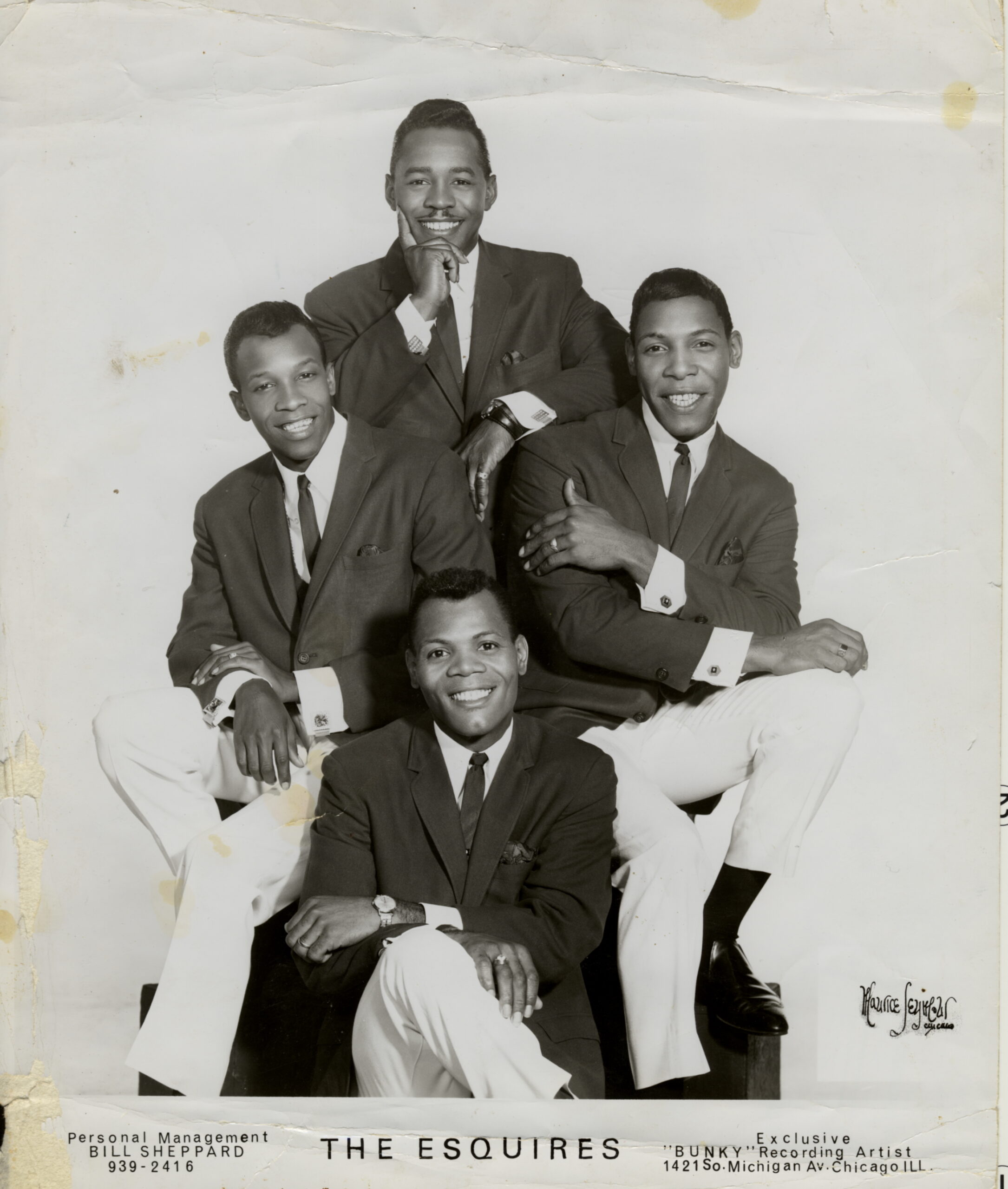
Okay, you are tuned to WHPK 88.5 FM in Chicago. You are now tuned to the _Sitting in the Park_ show. Today is a special show because it’s going to be an all-Esquires day, and we’re going to start off the show with an interview with Sam Pace, original member of the Esquires. He’s on the phone right now from Milwaukee. Sam, can you hear me?
**Sam Pace** 00:25
Yes, I can.
**Bob Abrahamian** 00:26
Okay, great. Thanks so much for being on the phone and telling your story. Throughout the show, we’re going to go over the history of the group and be playing their records, so it should definitely be interesting.
As you might know, the Esquires are from Milwaukee, but I still think of them as probably one of the greatest Chicago soul groups, having recorded in Chicago, and all their records have that great Chicago sound.
So, Sam, can you start by talking about how you got started singing?
**Sam Pace** 00:58
Yes. Well, it was back in the ’60s, you know. Alvis’s brother-in-law is what led me to them. I used to hear them practice all the time, so I always wanted to meet them.
**Bob Abrahamian** 01:15
Are you originally from Milwaukee?
**Sam Pace** 01:17
No, no. I’m from Kansas City.
**Bob Abrahamian** 01:20
Okay. And did you actually sing back when you were in Kansas City, too?
**Sam Pace** 01:24
Yes, I was singing. I had a little group back in Kansas City.
**Bob Abrahamian** 01:27
Do you remember the name of your group?
**Sam Pace** 01:29
Well, I don’t even think we named it back then. We were just starting off.
**Bob Abrahamian** 01:34
So were you in grade school back then, or high school?
**Sam Pace** 01:38
No, I was in junior high.
**Bob Abrahamian** 01:40
Okay. So what year did you move to Milwaukee?
**Sam Pace** 01:43
I moved here in, I think it was ’62.
**Bob Abrahamian** 01:47
Okay.
**Sam Pace** 01:48
Yes, it was ’62, I remember.
**Bob Abrahamian** 01:51
And you were talking about how you knew the two brothers from the Esquires?
**Sam Pace** 01:57
Yes. I knew Alvis’s wife’s brother. We went to a school called Rufus King. I was sitting on the porch, and I kept hearing all this singing. I said, “Man, somebody is singing.”
He said, “You want to meet them?”
I said, “Yeah.”
So that’s how he took me down there. One night they were rehearsing, and one of the guys didn’t show up. He kept saying, “Well, Sammy can do that note.”
And I kept saying, “[unclear], man, that’s [unclear], you know.”
So Alvis said, “Man, can you sing it?”
I said, “Yeah,” and I sang. So that’s how I got in.
**Bob Abrahamian** 02:39
So who were you watching practice? Was it Alvis?
**Sam Pace** 02:42
At the time, the group was called Betty Moore and the Esquires.
**Bob Abrahamian** 02:48
Okay.
**Sam Pace** 02:49
You know, it was Betty, Gilbert, Alvis, and they had another guy named Carl who was doing the part that I sing now.
**Bob Abrahamian** 02:59
So originally, the people you met were Betty Moore, Gilbert Moore, Alvis Moore, and someone named Carl?
**Sam Pace** 03:07
Carl Campbell, yes.
**Bob Abrahamian** 03:08
Carl Campbell was the name.
**Sam Pace** 03:10
Yes. He was doing that part. But then at the second rehearsal, he didn’t show, and I already had a foot in there, so I was at all the rehearsals.
Johnny—John Garland—kept telling them, “Well, Sammy can do the note,” because Carl didn’t show up. That’s how that happened.
**Bob Abrahamian** 03:32
So John Garland was your friend who took you to see them?
**Sam Pace** 03:34
Yeah. That’s Alvis’s wife’s brother.
**Bob Abrahamian** 03:36
Okay. So did you join the Esquires at that point?
**Sam Pace** 03:41
Yeah, it was a little here and there, because they wanted me to—I mainly wanted to do background, but they wanted me to lead a song. And when I heard how they sang, I was scared to death.
**Bob Abrahamian** 03:56
Just because they were really tight singing?
**Sam Pace** 03:58
Yeah, yeah. I was kind of scared to death. But anyway, Alvis and Betty talked to them and let me go on into the background, and I came from the background and went on from there.
**Bob Abrahamian** 04:11
Back then, one thing I think of when I think of the Esquires is that all the songs have that really high, almost falsetto lead. Were they singing that way back in ’62?
**Sam Pace** 04:23
Well, no, because Betty was doing all the leading.
**Bob Abrahamian** 04:27
Okay.
**Sam Pace** 04:27
And actually, Gilbert was doing the bass. He’s the one doing all the top stuff now. Me and him do all the high stuff now.
**Bob Abrahamian** 04:38
So he’s the guy singing the really high lead on most of the tracks, but he was actually singing bass back then?
**Sam Pace** 04:43
Yeah. Back then, when Betty was in the group, he was doing the bass.
**Bob Abrahamian** 04:48
And—
**Sam Pace** 04:48
He jumped from that. And so when she left and went to the Organizers—she was doing jazz—then that left me, Alvis, and Gilbert.
**Bob Abrahamian** 04:58
So she was with Odell Brown and the Organizers?
**Sam Pace** 05:00
Yeah. They were out of Chicago, too.
**Bob Abrahamian** 05:03
So she was singing at their shows and on the records and stuff? She was the female voice with the group?
**Sam Pace** 05:08
Right, right.
**Bob Abrahamian** 05:09
And what year did she leave?
**Sam Pace** 05:12
You know, I’ve forgotten. I’m trying to figure—it had to be before “Get On Up” came out, around that same time. I figure about ’66 or something like that.
**Bob Abrahamian** 05:24
And you had been telling me before that you guys actually did a recording before “Get On Up.” Is that right?
**Sam Pace** 05:31
Oh yeah, yes. There was a group here called the Bonnevilles, and we did background work with them. And then before that, I think it was Harvey Scales or something. They did something before I got in the picture.
**Bob Abrahamian** 05:50
But you’re actually on record on an album by the Bonnevilles, is that right?
**Sam Pace** 05:55
Oh yes.
**Bob Abrahamian** 05:56
So that’s a Milwaukee rock group or something like that?
**Sam Pace** 06:00
Yes, that’s a rock group from here.
**Bob Abrahamian** 06:01
And they cut a whole album, is that right?
**Sam Pace** 06:04
Yes, they did.
**Bob Abrahamian** 06:04
When did that come out?
**Sam Pace** 06:06
I don’t know when the release came out, but I know I was still going to school, so it had to be around ’63, something like that.
**Bob Abrahamian** 06:16
So they cut an album, and you guys sang on some of the songs?
**Sam Pace** 06:21
Yes. We were getting booked—I forgot who the agent was that had us booked—and we were on the same show with them. Then they asked us if we wanted to do the backup work with them. So we said yes, and that’s how we hooked up. Then we all started doing all kinds of gigs together.
**Bob Abrahamian** 06:46
So you were touring mainly around Milwaukee, the Milwaukee area?
**Sam Pace** 06:50
Yes.
**Bob Abrahamian** 06:51
Can you talk about what the scene was like at that time? Did you do shows with other Milwaukee groups like Harvey Scales and the Seven Sounds?
**Sam Pace** 07:00
Yes. There were a lot back then. There were a lot of bands here.
**Bob Abrahamian** 07:04
What were some of the other big bands?
**Sam Pace** 07:05
The Cheaters, and—I don’t know, let me see, I’m trying to think. But I’m telling you, it was flooded with bands.
**Bob Abrahamian** 07:15
And what type of shows did you guys do? Were they nightclubs, sock hops? What kind of venues did you do?
**Sam Pace** 07:21
We did mostly nightclubs. We were a nightclub act, you know, and did skits and stuff.
**Bob Abrahamian** 07:28
I know when Harvey Scales was up here telling his story, he was talking about how a lot of the shows they did were for white college audiences—
**Sam Pace** 07:38
Oh yes, mostly fraternities back then. Yes. We were doing a lot of up-north things. You know, “up north” means around Green Bay, Oshkosh, and all around in there. So we did a lot of those.
**Bob Abrahamian** 07:52
Did that group, the Bonnevilles, become your backing band at the shows?
**Sam Pace** 07:56
Yes, they backed us. Then they changed their name. I forget what their name was after they changed it, but they were pretty big back then.
**Bob Abrahamian** 08:06
Okay. So you basically gigged around Wisconsin from when you joined in ’62 through ’67, when “Get On Up” came out. Is that right?
**Sam Pace** 08:19
Yes.
**Bob Abrahamian** 08:20
So what’s the story? First of all, you said Betty Moore left right before “Get On Up” came out.
**Sam Pace** 08:26
Yeah, she did. Like I said, she had gone with the Organizers, because she was a jazz singer anyway.
**Bob Abrahamian** 08:35
So after she left, there were four of you?
**Sam Pace** 08:38
There were just four of us there.
**Bob Abrahamian** 08:40
So what’s the story? How did you come to Chicago to do “Get On Up”?
**Sam Pace** 08:48
Oh yeah. We used to love the Impressions, so we kind of built our thing around them. We did all their songs. When our lead singer had left, we used to do all the Curtis Mayfield and Impressions stuff.
When we started writing songs, we sounded so much like them. So they said, “Well, look, man, Curtis is already out here making money.”
We went to every record company up and down Michigan Avenue. At that time, that’s what was going on—Chess Records and all those, you know. And they said, “Hey, look, when you get your own sound, come back. We may be able to do something.”
So that’s how that was. We came back here.
**Bob Abrahamian** 09:38
By “get your sound,” you mean they wanted you to sound different from the Impressions?
**Sam Pace** 09:41
Right.
**Bob Abrahamian** 09:42
Okay. So you came back to Milwaukee to try to fine-tune your sound?
**Sam Pace** 09:47
Right. We went back, went in the basement, and came up with something. We started off with a song we named “Stick Shift,” and we had a little dance to it. And “Stick Shift” came to be “Get On Up.”
**Bob Abrahamian** 10:00
Okay, so is that where you first came up with that kind of high falsetto lead?
**Sam Pace** 10:05
No, we always did that after Betty left the group. We were always doing that high stuff.
**Bob Abrahamian** 10:13
And were you saying you were inspired by Curtis Mayfield?
**Sam Pace** 10:16
Yes, we were. As a matter of fact, the Impressions were our managers for a while.
**Bob Abrahamian** 10:21
You’re saying the Impressions were your managers?
**Sam Pace** 10:23
Yes. Yes, they were.
**Bob Abrahamian** 10:25
And did you sing lead on any of the tracks too, or who did those high falsetto parts? Was it mainly Gilbert and Alvis?
**Sam Pace** 10:31
It was me and Gilbert.
**Bob Abrahamian** 10:32
Okay. So after you fine-tuned your sound, did you come back to Chicago?
**Sam Pace** 10:38
Yes, we did. We went up and down Michigan Avenue, and we came to Constellation Records. Bunky Shepard was there at the time. I think Gene Chandler was on that label.
**Bob Abrahamian** 10:51
Yeah, he was probably the biggest star on the label.
**Sam Pace** 10:53
Yes. But Bunky told us, “Look, man, I like this.” He said, “I’ll cut it in two weeks,” and that blew my mind. We never thought anybody was going to do anything for us.
So we came back to Milwaukee, and he called and said, “Man, come back over here next week.” And that’s how we met Tom Tom.
**Bob Abrahamian** 11:14
Okay.
**Sam Pace** 11:17
Tom Tom was the arranger for most all of our stuff.
**Bob Abrahamian** 11:20
So were you still only three members at that time?
**Sam Pace** 11:24
No, oh no. We had hooked up with Shawn Taylor.
**Bob Abrahamian** 11:30
Okay. When did Shawn join the group?
**Sam Pace** 11:32
Shawn joined the group right before we did that, right before we recorded “Get On Up.”
**Bob Abrahamian** 11:42
How did you meet Shawn?
**Sam Pace** 11:44
Shawn knew the family way before I did, and then I got to know him. After a while, everybody knew everybody by then. So he was singing with us.
**Bob Abrahamian** 11:57
Do you know if Shawn had ever sung in a group before singing with you guys?
**Sam Pace** 12:06
I think he was a solo singer. I know he was hanging around Sam Cooke and all around in there.
**Bob Abrahamian** 12:11
You’re saying he was around Bobby Womack?
**Sam Pace** 12:13
Yeah, he was with Bobby Womack and company, and around Sam Cooke. That’s what he was doing.
**Bob Abrahamian** 12:23
So what part did he sing in the harmony?
**Sam Pace** 12:25
Oh, he was the baritone singer.
**Bob Abrahamian** 12:28
He was a what?
**Sam Pace** 12:28
He was baritone and lead. He did “Listen to Me.”
**Bob Abrahamian** 12:32
Okay.
**Sam Pace** 12:33
That was him leading that.
**Bob Abrahamian** 12:34
Oh, okay. So you said you came to Chicago and hooked up with Bunky Shepard at Constellation, and he and Tom Tom recorded you.
**Sam Pace** 12:44
Yes.
**Bob Abrahamian** 12:46
And I know you had another member from Chicago join. Had he joined by then? Was he on “Get On Up” also?
**Sam Pace** 12:54
No. How that happened—Millard Edwards was recording. He was with Bunky too.
**Bob Abrahamian** 13:03
Okay.
**Sam Pace** 13:03
And he was in the studio recording.
**Bob Abrahamian** 13:06
And he had previously been in the Sheppards too, right?
**Sam Pace** 13:10
Oh yes. He was the lead singer for the Sheppards. He was recording, and we were doing background work with him.
He was out there listening while we were doing that “Get On Up” thing, and he heard that bass part. He came in and said, “I hear something.”
So Bunky said, “Well, go in there.” And that’s how that bass part on “Get On Up” came in.
**Bob Abrahamian** 13:36
So does he do the bass on that record?
**Sam Pace** 13:40
Yes. That’s him doing the bass.
**Bob Abrahamian** 13:42
So you guys were already recording behind him—I know he had a solo record on Constellation—and then he was at your session, heard you guys recording, and added that part?
**Sam Pace** 13:54
Right, because we were both recording on the same day. Instead of having two dates, they had Millard do his thing, and then we came in and did ours. So we were on the same date.
**Bob Abrahamian** 14:07
So Millard added the low “Get on up” part after the high part, pretty much?
**Sam Pace** 14:12
Right, right.
**Bob Abrahamian** 14:14
Okay, well, we’ve been talking for a while. Let me play the record, and then we can talk a little bit more.
So this is the Esquires’ first record as the Esquires, and this is “Get On Up.”
**[Music Playing — The Esquires, “Get On Up”]** 14:30–16:50
**Bob Abrahamian** 16:50
Okay, that was the Esquires with their very first record, which was a huge national hit called “Get On Up.”
And if you’re just tuning in, I have Sam Pace, a member of the Esquires, on the phone talking about his music.
So on that record, who sings lead on it?
**Sam Pace** 17:10
That’s Gilbert Moore. Gilbert is our lead singer.
**Bob Abrahamian** 17:15
And what part do you sing on it?
**Sam Pace** 17:18
Well, I’m right up under him. I’m doing second tenor—sometimes first, sometimes second.
**Bob Abrahamian** 17:24
And what part does Alvis sing?
**Sam Pace** 17:27
Alvis is really a tenor, but because Shawn is doing baritone, we had first tenor, second tenor, baritone, bass.
**Bob Abrahamian** 17:36
Okay. And the bass, we just talked about, was Millard Edwards.
**Sam Pace** 17:39
Yes.
**Bob Abrahamian** 17:40
So when you cut that record, did you have some idea that it was going to be such a big hit?
**Sam Pace** 17:45
No, we didn’t. We were just doing local club work, you know. We had a band out of Minnesota that we worked with a lot, so we decided to put it together and went to the studio and did a demo.
We liked it, but we didn’t know. You don’t know, you know. And that’s when we went over there.
**Bob Abrahamian** 18:12
So when you took it to Bunky, you actually played him a demo version that you had cut? You didn’t just sing it for him—you had a recorded version that you played for him?
**Sam Pace** 18:22
No, we played a demo.
**Bob Abrahamian** 18:23
So that was like a studio acetate, like a dub that you cut in the studio?
**Sam Pace** 18:28
I mean, you know, you couldn’t play it too many times.
**Bob Abrahamian** 18:34
Do you know if any copies still exist of that original demo version?
**Sam Pace** 18:38
No, I don’t. No, I doubt it.
**Bob Abrahamian** 18:41
No? Okay. It would be cool to hear that first demo version that you came up with.
So did you actually sign a contract with Bunky?
**Sam Pace** 18:49
Yes.
**Bob Abrahamian** 18:50
And did you think it was originally going to come out on Constellation Records?
**Sam Pace** 18:56
You know, we were so excited, we didn’t know. Yes, we thought it was going to come out on Constellation.
But when they pressed everything and we received some copies to take to the jocks, we saw Bunky Records on them. So we didn’t know what was happening.
**Bob Abrahamian** 19:16
Okay. Well, he was pretty successful with his own label, and I know Constellation didn’t last much longer, so it was probably good that you got on the new label.
When that record broke, did it become a hit very quickly? What was the story?
**Sam Pace** 19:34
No, they called it a sleeper, you know, because we had those different kinds of licks in there with the bass and all that. So I guess people had to wait and say, “Whoa, okay.”
At that time, James Brown and Aretha Franklin had the top charts. That’s all you heard back in the day. Then we came in with that freak sound, and it took some time for it to catch on. But they called it a sleeper.
**Bob Abrahamian** 20:02
Okay, so that record crossed over to pop too? It got white radio play and Black radio play?
**Sam Pace** 20:10
Oh yes, it hit the pop charts. And of course, they thought we were white.
**Bob Abrahamian** 20:15
Okay, you’re saying the white radio stations thought you were white artists?
**Sam Pace** 20:19
Yes. We were getting booked in all kinds of places, you know, supper clubs. We’d go in there with a seven- or eight-piece band, and they’d be up there eating steaks and everything. We scared those people to death.
**Bob Abrahamian** 20:36
So they were surprised when Black guys came out, you’re saying?
**Sam Pace** 20:40
Yeah.
**Bob Abrahamian** 20:40
Did that record get more play on pop radio than it did on R&B radio?
**Sam Pace** 20:50
That record looked like it was coming out of the sidewalks. Everybody played it—pop and R&B. It was like it was coming out of the sidewalks. Everywhere I turned, I’d be hearing it.
And I sang it so much that one time I forgot my lyrics.
**Bob Abrahamian** 21:08
So after that, did Millard Edwards become a permanent member of your group because of that record?
**Sam Pace** 21:14
Yes. Yeah.
**Bob Abrahamian** 21:16
So originally he was just on the record, and then you decided to put him in the group because the record was such a big hit? Is that the story?
**Sam Pace** 21:24
Yeah, mainly. And then, see, he had more experience than we had on the road. Mainly, he was showing us the ropes, because we were just in Milwaukee.
He had been with the Sheppards, so he knew the ins and outs and everything. He was like a big brother to us.
**Bob Abrahamian** 21:48
So was he older than you guys?
**Sam Pace** 21:50
Well, yeah. Not that old.
**Bob Abrahamian** 21:52
Well, you guys had been around for a while too. And you said you had been doing supper clubs. Were you talking about clubs in Chicago or outside of Chicago?
**Sam Pace** 22:02
No, when I meant supper clubs, I meant when we started working off “Get On Up.” They didn’t know—I don’t know—but they thought we were white, I guess.
**Bob Abrahamian** 22:15
Yeah, I’m just asking where the clubs were. Did you start touring nationally?
**Sam Pace** 22:19
Yes. Wow, so many places. We’ve been so many places.
**Bob Abrahamian** 22:30
Was that the first time you were doing music full-time, or were you already doing music full-time when that came out?
**Sam Pace** 22:36
Yes, we were always doing music. We were working every week.
**Bob Abrahamian** 22:41
Okay. So Bunky ended up cutting a lot of records on you, and he cut a whole album. Pretty much all the records are great. I mean, you’re one of the few groups that cut a lot of records and pretty much never cut a bad record.
The harmonies are really nice, and you have that distinctive falsetto harmony that’s really tight on all the records.
**Sam Pace** 23:06
Thank you.
**Bob Abrahamian** 23:07
So I want to play one of the other records you cut on Bunky Records before we move on to the other labels you recorded for.
This track is called “Everybody’s Laughing,” and then we’ll talk a little bit more.
**Sam Pace** 23:23
Okay.
**[Music Playing — The Esquires, “Everybody’s Laughing”]** 23:34–26:00
**Bob Abrahamian** 26:00
Okay, that was the Esquires with one of the many excellent records they cut for Bunky Shepard on his Bunky record label. That track was called “Everybody’s Laughing.”
And if you’re just tuning in, I have Sam Pace on the phone. Sam was a member of the Esquires, and he is talking about his group’s music, and we’re playing their records, so you should definitely keep tuned.
Sam, besides “Get On Up,” what was the biggest record—the one that got the most play—that came out on the Bunky label?
**Sam Pace** 26:42
Well, that second one was called “Get Away.”
**Bob Abrahamian** 26:46
Okay.
**Sam Pace** 26:47
And that came—that knocked us out. That did pretty good for us.
**Bob Abrahamian** 26:53
Okay. And in Chicago, did you get any play on, for example, “Everybody’s Laughing”? Did that get any play?
**Sam Pace** 27:05
Yes. It wasn’t a single, but it was on the album.
**Bob Abrahamian** 27:11
Yeah, actually I played it off a single.
**Sam Pace** 27:13
Oh, you played—yeah?
**Bob Abrahamian** 27:14
It’s a B-side. I think it’s the flip of “Get Away.”
**Sam Pace** 27:19
Oh, okay. We were doing so many things back then.
**Bob Abrahamian** 27:24
Yeah, you cut a lot of great tracks. A lot of groups will cut a few good tracks and put throwaway songs on the B-side, but you cut a lot of nice cuts.
One thing I wanted to ask was, were you still living in Milwaukee at the time?
**Sam Pace** 27:39
Yes. We always lived here.
**Bob Abrahamian** 27:41
So were you traveling back and forth to Chicago a lot?
**Sam Pace** 27:45
Right. Chicago was really like home, you know. We were there just about as much as we were here.
**Bob Abrahamian** 27:55
And did you practice with Millard Edwards? He still lived in Chicago, right?
**Sam Pace** 28:00
Right.
**Sam Pace** 28:02
We had a practice room, and that’s where we did a lot of our rehearsing. We’d come in and stay with Millard, or we’d stay at Bunky’s house.
**Bob Abrahamian** 28:13
Okay.
**Sam Pace** 28:13
We stayed there until we got it right.
**Bob Abrahamian** 28:16
So how often did you come into town to practice?
**Sam Pace** 28:19
Whenever it was needed. We might come in on a Monday, and by Wednesday we’d be back here, whenever we got it right.
**Bob Abrahamian** 28:32
Okay, so you’d be in almost every week, practicing for a few days. And you said you were touring a lot too. What were some of the big acts you played shows with?
**Sam Pace** 28:43
Oh, wow. I did shows with Glen Campbell. What’s his name—Diamond? I forgot his name.
**Bob Abrahamian** 28:52
Neil Diamond.
**Sam Pace** 28:53
Neil Diamond.
**Bob Abrahamian** 28:54
Okay.
**Sam Pace** 28:55
And James Brown, Aretha Franklin. I think I’ve been with everybody. We’ve been on shows with everybody—Marvin Gaye, the Miracles, Gladys Knight and the Pips, the Intruders.
**Bob Abrahamian** 29:11
So the white acts you just mentioned—did you do shows with them at the supper-club type venues?
**Sam Pace** 29:16
No. A lot of the things we were doing were for colleges.
**Bob Abrahamian** 29:22
Okay.
**Sam Pace** 29:23
That’s when we did things with Neil Diamond. We did some things for colleges and stuff like that.
**Bob Abrahamian** 29:29
What were some of the big colleges you played?
**Sam Pace** 29:31
You know, I don’t remember. Back then, you’d just pull up, you were there, you’d get out, do your thing, and get back in the ride.
**Bob Abrahamian** 29:41
And did you guys have—
**Sam Pace** 29:43
We did a lot of stuff in the South too—North Carolina, South Carolina, a lot of colleges down through there.
**Bob Abrahamian** 29:50
Okay. Did you guys have a band that you traveled with too?
**Sam Pace** 29:54
Yes.
**Bob Abrahamian** 29:55
Who was the band? Were they a Milwaukee band?
**Sam Pace** 29:59
Yes. It was family—our brothers. Perry Moore, Giles Moore. They called themselves the Navajo Train.
**Bob Abrahamian** 30:08
The band was called the Navajo Train?
**Sam Pace** 30:10
Yeah.
**Bob Abrahamian** 30:11
And members of the Moore family were in the band?
**Sam Pace** 30:15
Right. Uh-huh.
**Bob Abrahamian** 30:16
And you guys, soon after the Bunky Records releases, went to Wand Records. Is that right?
**Sam Pace** 30:23
Yes.
**Bob Abrahamian** 30:24
Was that still through Bunky Shepard?
**Sam Pace** 30:26
Yes, it was. It was like a merger thing, because it was moving kind of fast.
**Bob Abrahamian** 30:32
Okay.
**Sam Pace** 30:33
And so Bunky worked some things out with them to meet the demand, because that “Get On Up” thing was moving real fast back there.
**Bob Abrahamian** 30:45
So what was the biggest hit record you cut on Wand Records?
**Sam Pace** 30:51
“You Got the Power.”
**Bob Abrahamian** 30:55
Okay, so I’m going to play that record, and then we can talk a little bit more.
**Sam Pace** 31:01
Okay.
**Bob Abrahamian** 31:01
This is the Esquires with a record they cut on Wand Records. Do you remember what year this came out? Was it around 1969?
**Sam Pace** 31:10
Yes.
**Bob Abrahamian** 31:11
And the lineup was the same as on “Get On Up,” is that right?
**Sam Pace** 31:15
Right.
**Bob Abrahamian** 31:15
Okay. So this is the Esquires with “You Got the Power.”
**[Music Playing — The Esquires, “You Got the Power”]** 31:15–34:00
**Bob Abrahamian** 34:00
That was the Esquires with their track “You Got the Power,” which came out on Wand Records, I think around 1969.
And if you’re just tuning in, I have on the phone Sam Pace, original member of the Esquires.
So on that cut, Sam, it’s pretty much the same members as on “Get On Up.” Is that right?
**Sam Pace** 34:21
Yes, it is.
**Bob Abrahamian** 34:22
And you guys ended up cutting another record on Wand called “I Don’t Know.”
**Sam Pace** 34:29
Yes.
**Bob Abrahamian** 34:30
And I think I’ve seen it in listings of the label, but you cut a third record called “Whip It on Me.” Did you actually record “Whip It on Me” as the Esquires?
**Sam Pace** 34:43
Yeah, we had done it first. But Bunky had sons who had a group, and instead of releasing it on the Esquires, we let them record it. We wrote that for them, and then they did it.
**Bob Abrahamian** 35:06
And the group that his son was in was called the Impalas. Is that right?
**Sam Pace** 35:11
Right.
**Bob Abrahamian** 35:12
And his son was Stan Shepard?
**Sam Pace** 35:16
Right.
**Bob Abrahamian** 35:17
So did you actually write that song?
**Sam Pace** 35:21
Yes, we wrote that. Yes.
**Bob Abrahamian** 35:22
Did you guys ever write anything else for any other groups?
**Sam Pace** 35:28
We did a lot of writing. At that time, we were mainly writing for ourselves, but we did other songs for people.
**Bob Abrahamian** 35:40
Did you guys write anything else that got recorded by anyone besides the Impalas?
**Sam Pace** 35:46
Yes. Prince did some things with some of our songs.
**Bob Abrahamian** 35:54
Prince recorded some of your songs?
**Sam Pace** 35:56
Prince did—but he didn’t record it himself. One of his people recorded it. They redid “Get On Up.”
**Bob Abrahamian** 36:06
Okay.
**Sam Pace** 36:06
Yeah.
**Bob Abrahamian** 36:07
But you didn’t write it for them. They basically covered the song, right?
**Sam Pace** 36:12
Right. We just got something in the mail saying that he wanted to record it, so we let them do it.
**Bob Abrahamian** 36:20
That was pretty nice.
Another thing you guys did was sing behind Betty Moore again, right?
**Sam Pace** 36:29
Right, right.
**Bob Abrahamian** 36:30
She cut a cover of “It’s My Thing,” backed with “Speed Up,” which was a great, great cut.
**Sam Pace** 36:39
Right.
**Bob Abrahamian** 36:40
Did she rejoin the group, or did you just cut that one record behind her? What was the story?
**Sam Pace** 36:46
Well, we recorded it for her.
**Bob Abrahamian** 36:51
Was she still with Odell Brown and the Organizers at that time?
**Sam Pace** 36:54
If I remember correctly, I think she was doing her own thing then.
**Bob Abrahamian** 37:03
Okay, so she was a solo artist?
**Sam Pace** 37:04
Yes. She did a lot of things on her own.
**Bob Abrahamian** 37:08
Did she sign to Wand, or did that record happen through Bunky also?
**Sam Pace** 37:13
Yes, yes.
**Bob Abrahamian** 37:14
Okay, so he probably produced that record.
After your Wand records, you guys were on a whole bunch of record labels. One label you were on was Lamar Records, which was a Chicago-based record label. I think Walter Gardner had something to do with the label.
And you cut what, in my opinion, was one of the greatest Chicago soul records of all time, “Girls in the City.”
**Sam Pace** 37:46
Yes.
**Bob Abrahamian** 37:47
Which I think is funny—a Milwaukee group doing one of the greatest Chicago soul records of all time. But when I hear this song, it just sounds so Chicago to me, and your harmonies are so tight on the record.
Do you remember how you got onto Lamar Records? Were you just signed with Bunky, and he put your stuff on different labels?
**Sam Pace** 38:07
Yeah. To tell you the truth, things were moving so fast, I don’t remember how we got on Lamar. But I know Bunky had something to do with it.
**Bob Abrahamian** 38:21
And the lineup was still the same, is that right?
**Sam Pace** 38:24
Yeah, the lineup was the same. The way I remember it, after we left Wand and things started slowing down a little bit, we looked around and had this other company. So that’s how that happened.
**Bob Abrahamian** 38:44
Okay.
**Sam Pace** 38:45
I’m trying to remember it all real fast, but it ain’t coming.
**Bob Abrahamian** 38:48
One thing that’s interesting about “Girls in the City” is, if you look at the songwriter, it’s actually Tony Hester, who was a Detroit songwriter. He mainly wrote for the Dramatics.
And there were some interesting Chicago-Detroit connections through Bunky. The track you did, “Dancing a Hole in the World,” was also done by a Detroit artist with the same backing track.
So you have no idea how Bunky had those Detroit connections, do you?
**Sam Pace** 39:20
No, I don’t. I heard about it at the time, but I think Bunky was already starting to move toward L.A.
**Bob Abrahamian** 39:36
Okay. Do you remember what year he moved to L.A.?
**Sam Pace** 39:44
Oh, I’d say the late ’70s.
**Bob Abrahamian** 39:53
Okay. Well, this stuff was coming out in the early ’70s, so I think this was still before then.
Let me play the record “Girls in the City,” and then we can talk a little bit more.
**Sam Pace** 40:04
Okay.
**Bob Abrahamian** 40:04
So this is the Esquires with a great record called “Girls in the City.”
**[Music Playing — The Esquires, “Girls in the City”]** 40:14–42:58
**Bob Abrahamian** 42:58
Okay, you are tuned to WHPK 88.5 FM in Chicago. You are listening to the _Sitting in the Park_ show.
And if you’re just tuning in, today is Esquires Day, where we’re playing the Esquires’ records. I have on the phone Sam Pace, an original member who was on pretty much all the Esquires’ records.
The track I just played was called “Girls in the City,” and that came out probably sometime around 1970 or ’71 on a Chicago record label called Lamar.
So, Sam, are you there?
**Sam Pace** 43:42
Yes, I’m still here.
**Bob Abrahamian** 43:43
Okay. Did that record get a lot of play in Chicago?
**Sam Pace** 43:47
Yes, it did. It got a lot of play.
**Bob Abrahamian** 43:51
And—
**Sam Pace** 43:52
People kind of caught on to it, you know.
**Bob Abrahamian** 43:54
Do you know if it got national play too, or was it more of a local hit in different cities?
**Sam Pace** 44:01
Yes, it was national.
**Bob Abrahamian** 44:03
Okay. So throughout the ’70s, were you guys touring?
**Sam Pace** 44:08
Yes, all that time.
**Bob Abrahamian** 44:10
And did your membership stay the same through most of the ’70s?
**Sam Pace** 44:15
No. Like I said, Sean was in and out of the group.
**Bob Abrahamian** 44:21
Okay.
**Sam Pace** 44:22
Most of the time, it was just me, Alvis, and Gilbert.
**Bob Abrahamian** 44:26
So you, Alvis, and Gilbert were the three core members of the group?
**Sam Pace** 44:29
Right.
**Bob Abrahamian** 44:30
And Sean—I know he cut a couple of records on the Magic Touch label in Wisconsin, just as Sean Taylor—but you’re saying he didn’t simply leave the group. He left and came back at different points?
**Sam Pace** 44:42
Yes, he did.
**Bob Abrahamian** 44:43
Is he singing on all the records I’ve played so far?
**Sam Pace** 44:46
Yes.
**Bob Abrahamian** 44:47
So he sings on all the Bunky stuff and on “Girls in the City.”
After that Lamar record, you were on a bunch of different record labels. You were on Capitol Records, and on Capitol you cut a track called “Reach Out and Listen to Me.”
**Sam Pace** 45:06
Right.
**Bob Abrahamian** 45:07
Did that record get any play?
**Sam Pace** 45:09
“Reach Out”… I’m trying to remember.
**Bob Abrahamian** 45:18
Do you know what the story was with Capitol Records at the time? I know the Impalas were also on Capitol for a second, and there were a bunch of Chicago artists on that label, so Bunky must have had some kind of deal with them.
Were you supposed to cut an album for them? Did you cut more material, or was it just that single?
**Sam Pace** 45:38
It was just that single we did when we were at Capitol.
**Bob Abrahamian** 45:41
Okay. Another record label you were on was Hotline Records, and that was actually based out of Nashville. Do you remember anything about that? Was that also pretty much through Bunky?
**Sam Pace** 45:54
That was through Bunky.
**Bob Abrahamian** 45:56
Okay. And you cut a side called “Henry Ralph” and “My Sweet Baby.” Did anything happen with those sides at all?
**Sam Pace** 46:05
Well, we got play on it. It didn’t do as well as we wanted it to, but it sold.
**Bob Abrahamian** 46:14
Okay. Actually, it was “Henry Ralph” and “My Sweet Baby.” I’m sorry, I said the side wrong.
Another label you were on around that time was called Rocky Ridge.
**Sam Pace** 46:24
Yes, we were on Rocky Ridge.
**Bob Abrahamian** 46:26
And if I look at the label, it says L.A., but it also says it’s a division of MGM Records. Did you ever sign with MGM, or was that also just through Bunky the whole time?
**Sam Pace** 46:35
It was through Bunky.
**Bob Abrahamian** 46:37
Okay, so he was basically placing your material on different labels, trying to get a hit.
**Sam Pace** 46:43
That’s how it broke down. Yes.
**Bob Abrahamian** 46:47
Do you think there’s any particular reason why—because the material was all really good, all the tracks you cut—you never had another hit as big as “Get On Up” in the ’60s? Was it just luck?
**Sam Pace** 47:03
Yeah, you could call it that. It was just time for something new, something different, and things changed, you know.
**Bob Abrahamian** 47:12
And did Millard Edwards stay with the group? How long did he stay?
**Sam Pace** 47:18
Mill was with us a long time.
**Bob Abrahamian** 47:22
Okay. So, for example, he sings on “Dancing a Hole in the World.”
**Sam Pace** 47:30
Yes.
**Bob Abrahamian** 47:31
And is Sean on that record too?
**Sam Pace** 47:34
I’m trying to remember. No, he’s not on that.
**Bob Abrahamian** 47:38
Okay. You cut a bunch of records before eventually going back and cutting some records on Milwaukee labels and a few other more local labels.
Let me play one of the records you cut, and then we can talk a little bit more.
This is the B-side of the record you cut on Hotline Records, and this is called “My Sweet Baby.”
**Sam Pace** 48:04
Okay.
**[Music Playing — The Esquires, “My Sweet Baby”]** 48:16–50:51
**Bob Abrahamian** 50:51
Okay, that was the Esquires with an excellent cut called “My Sweet Baby.” I think it came out sometime in the early ’70s on one of the many record labels that Bunky Shepard placed their records with.
Around that time, I think one of the last records you cut with Bunky was a remake of “Get On Up.” It was called “Get On Up ’76.”
**Sam Pace** 51:20
Yes.
**Bob Abrahamian** 51:20
And it was actually on a Detroit record label called Ju-Par Records.
**Sam Pace** 51:26
Right.
**Bob Abrahamian** 51:27
Did you record it in Detroit?
**Sam Pace** 51:30
No, we did that in Chicago.
**Bob Abrahamian** 51:32
Okay. Did you cut pretty much all your records in Chicago?
**Sam Pace** 51:35
Yes. We did those there. The last two or three, we did in L.A.
**Bob Abrahamian** 51:40
Oh, the last two or three records you actually cut in L.A.?
**Sam Pace** 51:43
Yes.
**Bob Abrahamian** 51:44
Okay. So that Ju-Par record label—you don’t know anything about it, do you?
Bunky’s son was later in a group called Live and Proof that was actually on that same label, and I think it eventually became part of Motown too. But you don’t know the story behind that label?
**Sam Pace** 52:03
I don’t have a clue what that was, you know.
**Bob Abrahamian** 52:05
Okay. On “Get On Up ’76,” was Millard Edwards still in the group?
**Sam Pace** 52:12
Pardon me?
**Bob Abrahamian** 52:13
Was Millard Edwards still in the group?
**Sam Pace** 52:16
Oh no, not at the time we did “Get On Up ’76.”
**Bob Abrahamian** 52:19
Okay. So how did he end up leaving the group? Did he just go and do his own music?
**Sam Pace** 52:26
Yeah. He wanted to reestablish himself and get back into his own music. Everybody was kind of looking that way at that time.
**Bob Abrahamian** 52:38
Okay.
**Sam Pace** 52:39
So it was just me and the brothers.
**Bob Abrahamian** 52:44
Okay. So the group then became mainly three guys: you, Sam Pace, and then Gilbert and Alvis Moore. Is that right?
**Sam Pace** 52:53
Right.
**Bob Abrahamian** 52:54
After that, did you stay affiliated with Bunky? His name isn’t on the last few records.
**Sam Pace** 53:02
No, no. We got another guy here out of Milwaukee named Flip.
**Bob Abrahamian** 53:09
Okay, what was his name? I think his name is on one of the records.
Yeah, it says J. Flippen is the producer. Is that him?
**Sam Pace** 53:19
Right, that’s him.
**Bob Abrahamian** 53:20
Okay. So you ended up cutting a record on the New World label out of Milwaukee.
**Sam Pace** 53:28
Right.
**Bob Abrahamian** 53:29
Do you remember what year that happened?
**Sam Pace** 53:31
Wow. Let me try to go back. That was about ’79, something like that.
**Bob Abrahamian** 53:44
Okay. And what was the lineup on this record? Was it still just the three of you, or did you get a new member?
**Sam Pace** 53:51
We had a friend with us named Pete Scott. He was in there. He was doing the part when they first come on. [unclear]
**Bob Abrahamian** 54:07
I didn’t catch his name. What’s his name?
**Sam Pace** 54:09
Pete Scott.
**Bob Abrahamian** 54:10
Pete Scott?
**Sam Pace** 54:12
Pete. Yes, Pete Scott.
**Bob Abrahamian** 54:13
Pete, like—?
**Sam Pace** 54:14
No, Pete. P-E-T—
**Bob Abrahamian** 54:17
Pete. I’m sorry. It’s hard—
**Sam Pace** 54:21
Peter.
**Bob Abrahamian** 54:23
Pete?
**Sam Pace** 54:23
Yes.
**Bob Abrahamian** 54:24
Okay, I’m sorry about that.
**Sam Pace** 54:25
Well, you can call him Peter Scott.
**Bob Abrahamian** 54:29
Yeah, it’s just hard with the phone connection, I think.
So this record you cut was “Let Me Build You a New World” and “Stay.”
**Sam Pace** 54:38
Right.
**Bob Abrahamian** 54:38
Did this get any play in Milwaukee, at least?
**Sam Pace** 54:40
Yes, it got good play. We got good airtime on that.
**Bob Abrahamian** 54:44
Which was the intended A-side?
**Sam Pace** 54:47
That was—
**Bob Abrahamian** 54:48
Which one was the A-side?
**Sam Pace** 54:50
“Let Me Build You a New World.”
**Bob Abrahamian** 54:51
Okay. I like the “Stay” side a lot. It’s a nice ballad track.
Where was this record recorded?
**Sam Pace** 55:00
We recorded it in Chicago.
**Bob Abrahamian** 55:02
Oh, in Chicago. Okay.
Let me play this record, and then we can talk a little bit more.
This is the Esquires, and this track is called “Stay.”
**[Music Playing — The Esquires, “Stay”]** 55:34–58:07
**Bob Abrahamian** 58:07
Okay, that was the Esquires from the late ’70s on a Milwaukee label called New World, and that track was called “Stay.”
Sam, do you remember who ran that label? Was it Flip?
**Sam Pace** 58:52
Yeah. Flip was the owner of the label.
**Bob Abrahamian** 58:56
Okay. And you said the side “Let Me Build You a New World” got play in Milwaukee and Chicago. Is that right?
**Sam Pace** 59:04
Yes.
**Bob Abrahamian** 59:05
And you said it was actually recorded in Chicago?
**Sam Pace** 59:07
Right.
**Bob Abrahamian** 59:08
And you said there was one other member, Pete. What was his last name again? Pete Scott?
**Sam Pace** 59:20
Yes, he’s from here. I’ve known him all my life.
**Bob Abrahamian** 59:23
Is he younger than you guys?
**Sam Pace** 59:25
We’re all around the same age.
**Bob Abrahamian** 59:28
Did Pete ever sing with any other groups?
**Sam Pace** 59:30
He and Sean had sung and recorded some things together.
**Bob Abrahamian** 59:35
Okay. Were there any other members who sang with you on any of your final records, or was Pete the only new guy?
**Sam Pace** 59:44
Yeah, it was just Pete at that time.
**Bob Abrahamian** 59:46
Okay, so it was a four-man group for your last few records.
**Sam Pace** 59:50
Yes, it was.
**Bob Abrahamian** 59:50
So one of your last couple of records came out on a Chicago label called Lasco Records, and it was called “The Fish.”
**Sam Pace** 1:00:00
Right.
**Bob Abrahamian** 1:00:00
And the flip side was called “My Lady.” Then you had one more record that came out on Cigar Man Records.
**Sam Pace** 1:00:09
Right.
**Bob Abrahamian** 1:00:09
And you were mentioning before that those were actually recorded in L.A.
**Sam Pace** 1:00:14
Yes, we recorded those in L.A.
**Bob Abrahamian** 1:00:16
What’s the story? How did you get to L.A. to do the recording?
**Sam Pace** 1:00:20
Well, Fred Darnell knew my father. We hooked up, and he said, “Well, I’ll do some things with you.”
So we got it together and went out to L.A.
**Bob Abrahamian** 1:00:38
Who was Fred Darnell?
**Sam Pace** 1:00:39
Fred Darnell—he was an old family friend.
**Bob Abrahamian** 1:00:44
But what did he do?
**Sam Pace** 1:00:46
He was a producer.
**Bob Abrahamian** 1:00:48
Oh, he produced the records?
**Sam Pace** 1:00:49
He produced those.
**Bob Abrahamian** 1:00:50
So you cut all of these at the same session in L.A.?
**Sam Pace** 1:00:55
Yes.
**Bob Abrahamian** 1:00:56
And they just ended up being put out on different labels?
**Sam Pace** 1:00:58
Right.
**Bob Abrahamian** 1:00:59
The first one that came out was “The Fish” and “My Lady.” It says on the record, “Produced by L. Farrow and J. Levine.” Do you know who those people are?
**Sam Pace** 1:01:11
Larry Farrow was the arranger.
**Bob Abrahamian** 1:01:15
Okay.
**Sam Pace** 1:01:15
And Jay Levine was the guy who had the label.
**Bob Abrahamian** 1:01:20
Okay, he had that Lasco Records label. Do you know how you got to the label or how you found those guys?
**Sam Pace** 1:01:26
He came to us. Like we used to do, we’d get in the car and go to Chicago, look around, and try to get with a label. We talked with him and decided we were going to go with that label. So that’s how it worked out.
**Bob Abrahamian** 1:01:48
So did you already have the record recorded and then place it on the label?
**Sam Pace** 1:01:52
We had gone out to L.A. and done it.
**Bob Abrahamian** 1:01:55
But they didn’t send you to L.A.? You already had it recorded, and then you just needed someone to put it out?
**Sam Pace** 1:02:02
Right. We needed a label for it.
**Bob Abrahamian** 1:02:04
Okay. And then the last record you did was on a label called Cigar Man.
**Sam Pace** 1:02:10
Right.
**Bob Abrahamian** 1:02:10
Do you know where that label was based?
**Sam Pace** 1:02:13
That was our label.
**Bob Abrahamian** 1:02:16
Oh, that was your own label?
**Sam Pace** 1:02:17
Right. That was our label.
**Bob Abrahamian** 1:02:18
So you pretty much put it out yourselves because you didn’t have another label to put it out?
**Sam Pace** 1:02:22
Right, right.
**Bob Abrahamian** 1:02:23
And you actually did more material at that same session that just never came out?
**Sam Pace** 1:02:30
No, it wasn’t released.
**Bob Abrahamian** 1:02:33
How much material did you cut at that session?
**Sam Pace** 1:02:36
We did about seven songs.
**Bob Abrahamian** 1:02:40
Did you ever intend to release an album?
**Sam Pace** 1:02:44
Yes, we were trying to. We were going to do it.
**Bob Abrahamian** 1:02:47
It just never came together?
**Sam Pace** 1:02:49
Right.
**Bob Abrahamian** 1:02:49
Okay. Well, let me play a nice cut off your last record. This is the B-side of the record.
Hold on—sorry. This track is called “What Good Is Music.” I blanked on the title.
So this is the Esquires with their very last record from 1980, and this is called “What Good Is Music.”
**[Music Playing — The Esquires, “What Good Is Music”]** 1:03:30–1:06:56
**Bob Abrahamian** 1:06:56
Okay, that was the Esquires with the last record they released, from 1980. That track was called “What Good Is Music,” and it came out on their own Cigar Man label.
And if you’re just tuning in, I have on the phone from Milwaukee Sam Pace, who was a member of the Esquires and sang on all their records.
So, Sam, did you guys do any more recording after that record from 1980?
**Sam Pace** 1:07:23
No.
**Bob Abrahamian** 1:07:26
Did you guys continue to perform?
**Sam Pace** 1:07:28
Yes, we still do. We still do our gigs and everything.
**Bob Abrahamian** 1:07:32
And the shows you do now—is it you, Gilbert, and Alvis, pretty much?
**Sam Pace** 1:07:38
Right. It’s just the three of us.
**Bob Abrahamian** 1:07:39
Do you do gigs mainly in Milwaukee?
**Sam Pace** 1:07:43
No, no. Minnesota, Detroit, and all over—North and South Carolina.
**Bob Abrahamian** 1:07:54
When was the last time you guys did a show?
**Sam Pace** 1:07:59
It’s been a while. It’s been at least about four or five months.
**Bob Abrahamian** 1:08:07
Okay. And Sean Taylor passed away, is that right?
**Sam Pace** 1:08:12
Yes, he passed.
**Bob Abrahamian** 1:08:13
Sometime in the ’90s?
**Sam Pace** 1:08:15
Yes.
**Bob Abrahamian** 1:08:16
Okay. And is Pete still around?
**Sam Pace** 1:08:20
No. Pete passed too.
**Bob Abrahamian** 1:08:23
Okay, that’s sad.
**Sam Pace** 1:08:24
Yes.
**Bob Abrahamian** 1:08:26
So pretty much none of you guys have recorded anything else since that record from 1980?
**Sam Pace** 1:08:33
No. We just do gigs.
**Bob Abrahamian** 1:08:36
Okay. Well, hopefully one day you’ll have more material released, or more of your old unreleased material will come out.
First of all, thanks so much for being on the phone and doing this interview. It was great to hear your story.
You guys are such an important—I mean, you had big hits. I consider you guys an important Chicago soul group, even though most of you weren’t actually from Chicago.
**Sam Pace** 1:09:00
Yeah, this is like home.
**Bob Abrahamian** 1:09:02
Do you have any last words for the listening audience?
**Sam Pace** 1:09:07
Just whenever we’re in Chicago and y’all hear about us, come out and see us.
**Bob Abrahamian** 1:09:12
Okay. And definitely let me know, because I’ll announce it.
**Sam Pace** 1:09:15
I will definitely let you know.
**Bob Abrahamian** 1:09:16
Okay, well, thanks again.
And for the rest of the show, I’ll be playing all Esquires records, because they cut so many great records.
This next record I’m going to play is the Esquires with a track they did on Bunky’s label called “State Fair.”
**Sam Pace** 1:09:37
All right.
**[Music Playing — The Esquires, “State Fair,” followed by additional Esquires selections]** 1:09:38–end