**Bob Abrahamian** 00:00
Okay, you are tuned to WHPK 88.5 FM in Chicago. You are listening to the _Sitting in the Park_ show. My name is Bob, and today we have a special show because I have up in the studio right now two members of the West Side Chicago group called the Intensions. So they'll be here telling the story of their group, and we will be playing their records. So you should definitely keep tuned.
First of all, I was wondering if you two guys could introduce yourselves.
**Jimmy Jordan** 00:33
I'm Jimmy Jordan from the Intensions.
**Bob Abrahamian** 00:36
Okay.
**Sam Tate** 00:37
My name is Sam Tate, also with the Intensions.
**Bob Abrahamian** 00:40
Okay. So first of all, as I mentioned, you guys are from the West Side of Chicago. Is that right?
**Sam Tate** 00:47
Yes.
**Bob Abrahamian** 00:47
Which specific streets are you guys from?
**Jimmy Jordan** 00:51
Well, I'm off Central and Lake Street.
**Bob Abrahamian** 00:54
So that's just where you are now?
**Jimmy Jordan** 00:55
Right.
**Bob Abrahamian** 00:56
But where were you back in the day?
**Jimmy Jordan** 00:58
Down by [unclear] and Jackson.
**Bob Abrahamian** 01:02
Okay. And—
**Sam Tate** 01:04
And I was on Jackson and [unclear].
**Bob Abrahamian** 01:07
Okay, so you guys were like a mile away from each other, pretty much. So you guys sang in high school, but you didn't form a group together in high school?
**Jimmy Jordan / Sam Tate** 01:18
No.
**Bob Abrahamian** 01:19
What schools did each of you go to?
**Jimmy Jordan** 01:22
Well, I went to Marshall. Me and one of the singers from the Intensions, named Eddie Moore, we both were from Marshall. That's when our original group started. We were the Continental Flames.
**Bob Abrahamian** 01:37
Okay. When was that? What years were you in school? Late '50s?
**Jimmy Jordan** 01:43
Yeah. Middle '50s.
**Bob Abrahamian** 01:47
Okay. So you don't remember what year you graduated? Was it before 1960?
**Jimmy Jordan** 01:51
Yes.
**Bob Abrahamian** 01:52
So you were in school singing with Eddie and with a group called the Continental Flames.
**Jimmy Jordan** 02:00
Right.
**Bob Abrahamian** 02:01
And you never recorded anything when you were in school?
**Jimmy Jordan** 02:04
No, not during that time.
**Bob Abrahamian** 02:05
And Sam, did you sing when you were in school too?
**Sam Tate** 02:08
Yeah. Well, it was after I got out of school. In fact, I was married when I met the Intensions. I was with a group called the Exciters, and I was attending Crane High School at the time.
**Bob Abrahamian** 02:18
Okay.
**Sam Tate** 02:18
And I left Crane in '62.
**Bob Abrahamian** 02:22
Okay. I think the Ideals were in your school around that time. Did you know any of them?
**Sam Tate** 02:26
No, not really.
**Bob Abrahamian** 02:27
Okay. And we were talking earlier—the most famous group that came out of your school, they were the Pharaohs, who became Earth, Wind & Fire.
**Sam Tate** 02:35
That's correct.
**Bob Abrahamian** 02:36
But they were in school later than you, right?
**Sam Tate** 02:38
Right, right. In fact, we lived on the same street, next door to each other.
**Bob Abrahamian** 02:42
Okay.
**Sam Tate** 02:42
On Oakley.
**Bob Abrahamian** 02:43
So you guys all sang pretty much in high school groups. How did the Intensions form? When did you guys form the Intensions?
**Jimmy Jordan** 02:53
Well, after the Continental Flames broke up, we lost one of the members, and we were auditioning for another singer. That's when Sam Tate auditioned for the group, and he became a Continental Flame at that time.
As time moved on, we were rehearsing at a place called Union Park, and we ran into a producer called George Redmond.
**Bob Abrahamian** 03:24
Wait, so first of all, how did you meet Sam? Did you just know each other from singing in the same places, or how did you know Sam?
**Jimmy Jordan** 03:33
Well, our group, the Continental Flames, was auditioning for a singer. So Sam—
**Bob Abrahamian** 03:37
Just came in and auditioned for you?
**Jimmy Jordan** 03:38
He found out about the audition, and he did.
**Bob Abrahamian** 03:41
Do you remember how you found out about the group?
**Sam Tate** 03:44
No. Like I said before, at that time you had a lot of street groups, singing groups, that would sing different places—competitions at the local parks and whatnot.
**Bob Abrahamian** 03:55
Okay.
**Sam Tate** 03:56
So this is the way I ran into these guys. They were looking for a singer, and I was looking to change groups at the time.
**Bob Abrahamian** 04:06
And one more thing. You were telling me earlier you were singing in a group called the Exciters, and you told me that you had some connection to the Steelers.
**Sam Tate** 04:14
Yeah, we all grew up together. Again, it was a neighborhood thing. The Steelers—we all grew up together. Part of the Steelers were in the Exciters, and we decided to look elsewhere, you know, to get into different groups.
**Bob Abrahamian** 04:30
Okay, so you ended up singing with Jimmy and Eddie then.
**Sam Tate** 04:36
Yes.
**Bob Abrahamian** 04:37
And were you still called the Continental Flames back then?
**Jimmy Jordan** 04:39
No, we came into contact with the producer George Redmond.
**Bob Abrahamian** 04:45
Well, before you came in contact with him, you were still called the Continental Flames. Do you remember around what year you guys all came together? It was early '60s sometime?
**Jimmy Jordan / Sam Tate** 04:54
Yeah, it had to be.
**Bob Abrahamian** 04:57
I would say around '61, '62?
**Jimmy Jordan / Sam Tate** 05:00
Yeah.
**Bob Abrahamian** 05:01
Okay. So then you were telling me George Redmond saw you. You were doing a show in a park?
**Jimmy Jordan** 05:06
Yeah, at Union Park. He came in because there were a lot of groups participating at that particular park, and he heard our group. He came to us and said he would like to record us.
**Bob Abrahamian** 05:18
Okay. So where was Union Park located?
**Jimmy Jordan** 05:21
[unclear] and—
**Sam Tate** 05:23
[unclear] and Ogden, and all the way back to, I think, Madison almost.
**Bob Abrahamian** 05:30
Okay.
**Sam Tate** 05:31
And that was the park area.
**Bob Abrahamian** 05:33
So it was just a park where groups got together and sang?
**Jimmy Jordan / Sam Tate** 05:39
Right.
**Bob Abrahamian** 05:40
And you guys had been out of high school for a while, right? You were just singing because it was an activity that you guys did. Did you have aspirations of recording? Did you want to record?
**Sam Tate** 05:50
I think that in any of the groups at that time, that was their main focus: "Hey, we'd love to record." And you'd look at the groups that were existing at the time and kind of pattern yourself after them, or, you know, look to sound like someone.
Like I said, one of the big features at that point—a lot of the groups sang in hallways because of the echo effect, or in the viaducts because of the echo effect.
**Bob Abrahamian** 06:13
Yeah. So George Redmond saw you at the park. Did you sign a contract with him? Did he take you to the studio right away? What happened?
**Jimmy Jordan** 06:23
Well, he didn't take us right away. The band that we had at that particular time, he wasn't quite satisfied with that band. That's when we came in contact with—what's the name of Quinton's band?
**Sam Tate** 06:46
You know, I don't recall their name as a band, because we kind of met them separately. We met a drummer here and a sax player here, or whatever, and we kind of formed our own thing. I know Quinton Joseph's band was later the Pieces of Peace, but I don't think that was the Pieces of Peace—
**Jimmy Jordan** 07:04
That became our band.
**Bob Abrahamian** 07:06
Yeah. I didn't know they were together that early, too. So you said you came in contact with George. What was the band you had before that? Did they even have a name?
**Jimmy Jordan** 07:19
Called [unclear].
**Bob Abrahamian** 07:20
Okay. They were—
**Jimmy Jordan** 07:21
Brothers.
**Bob Abrahamian** 07:21
So when you played in the park, did the band play with you, or was it just when you did shows?
**Jimmy Jordan** 07:27
No, the band played with us in the park.
**Bob Abrahamian** 07:29
Okay. You rehearsed in the park with the band and everything?
**Jimmy Jordan / Sam Tate** 07:34
Yeah.
**Bob Abrahamian** 07:35
That's interesting. I thought the park was just a bunch of guys singing, but you actually had a band set up there playing with you.
**Jimmy Jordan / Sam Tate** 07:42
Right.
**Bob Abrahamian** 07:43
And so George ended up recording you guys. Let me play your first record, and then we can talk some more. This is the Intensions with "I Just Can't Win."
**[music playing]** 07:56
The Intensions — “I Just Can’t Win”
**Bob Abrahamian** 09:38
Okay, that was the Intensions from the West Side of Chicago with their very first record, “I Just Can’t Win.”
And if you’re just tuning in, I have two members of the Intensions, Jimmy Jordan and Sam Tate, talking about their group, their story, and their history.
So that record I just played was their very first record, and I think it came out around 1966, sometime around there. Before I played the record, we were talking about how you guys had actually met the label owner, George Redmond, around ’62. He saw you guys in the park. So it was a few years before he actually recorded you.
You don’t know why it took so long?
**Jimmy Jordan** 11:08
I think he had a little financial problem.
**Bob Abrahamian** 11:10
Okay. And that record came out on his label called Moneytown, which he had at the time.
**Jimmy Jordan** 11:16
Right.
**Bob Abrahamian** 11:17
So were you guys doing shows too, or was it mainly just singing in the park?
**Jimmy Jordan** 11:23
We were doing shows.
**Bob Abrahamian** 11:24
Okay. And what were some of the places where you were doing shows at the time?
**Sam Tate** 11:29
There was a place on State and 55th, and I forget what it was called—the club. We did shows there, and we did shows at some of the local [unclear] clubs and things like that. Regular dance hangouts.
**Bob Abrahamian** 11:48
And that was even before you had a record out. You were doing shows?
**Jimmy Jordan / Sam Tate** 11:52
Right.
**Bob Abrahamian** 11:53
What type of stuff did you do before you had a record out, when you had shows?
**Sam Tate** 11:54
Well, naturally, we would do other people’s records. You know, we were very good at that.
**Bob Abrahamian** 12:00
Okay. And that song that I just played, “I Just Can’t Win”—did you guys all write that song together?
**Sam Tate** 12:07
Yeah.
**Bob Abrahamian** 12:08
Okay. And who sang lead on that record?
**Sam Tate** 12:11
Eddie. Eddie Moore. He’s no longer with us, but Eddie was the lead singer on that.
**Bob Abrahamian** 12:17
Okay. And a lot of groups had different lineups, but your group pretty much always had the same three guys in it. Is that right?
**Jimmy Jordan / Sam Tate** 12:29
Yeah.
**Bob Abrahamian** 12:30
So that record got released, like I said, around 1966. Did it get any radio play at all when it came out?
**Jimmy Jordan** 12:34
Not too much. Very little.
**Bob Abrahamian** 12:37
Okay. So he just didn’t promote it very well?
**Jimmy Jordan / Sam Tate** 12:42
Yeah.
**Bob Abrahamian** 12:43
Because he released a lot of records on you. I think your biggest record was called “I Don’t Care Anymore.”
**Jimmy Jordan** 12:49
Correct.
**Bob Abrahamian** 12:52
Okay. So that record got released, and then he released a second record on you on his Moneytown label called “I’ll Be Lost.”
Did you record that around the same time, or did you record it later?
**Sam Tate** 13:04
No. A lot of the recordings we did, we were going into studios with two or three records to do. It was not a one-shot deal.
**Bob Abrahamian** 13:12
Do you remember what studios you went to record?
**Sam Tate** 13:16
Columbia was one.
**Bob Abrahamian** 13:19
And you went to Paul Serrano’s studio?
**Sam Tate** 13:22
Yeah.
**Bob Abrahamian** 13:23
Okay. And where was the Columbia studio?
**Sam Tate** 13:25
North side of downtown Chicago. I don’t recall exactly where it was at this point. That’s been a number of years ago.
**Bob Abrahamian** 13:35
Okay. So let me play your second record, and we’ll talk some more. I really like this one. This is called “I’ll Be Lost.”
**[music playing]** 13:57
The Intensions — “I’ll Be Lost”
**Bob Abrahamian** 16:17
Okay, you’re tuned to WHPK 88.5 FM in Chicago. If you’re just tuning in, I just played the Intensions with “I’ll Be Lost,” and two of the members of the Intensions are up here right now talking about their group and the story of their group.
So the record I just played again was called “I’ll Be Lost,” and it also came out on George Redmond’s Moneytown label. You guys were telling me earlier that you actually thought the song might not have been released because you said there was something wrong with it. What’s the story?
**Jimmy Jordan** 16:52
George said he wanted the harmony after the modulation. He said the harmony wasn’t [unclear]. He wanted to go back in the studio and redo it.
**Bob Abrahamian** 17:08
Okay.
**Jimmy Jordan** 17:09
So therefore, we never knew it. We never knew it had even come out.
**Bob Abrahamian** 17:13
He probably just pressed it, and you didn’t know about it.
And the other side of the record is interesting because it’s called “London Bridge Is Falling Down.” It’s about losing a girl in London, and Gene Chandler had a similar song called “London Town” around the same time.
But that record obviously didn’t get any play, since you didn’t even know it came out.
**Jimmy Jordan / Sam Tate** 17:34
Right.
**Bob Abrahamian** 17:35
Do you remember who the band was playing on the record?
**Jimmy Jordan** 17:38
That’s the [unclear] Movement.
**Bob Abrahamian** 17:44
An early version of the Pieces of Peace, actually?
**Jimmy Jordan / Sam Tate** 17:48
Right.
**Bob Abrahamian** 17:49
That’s interesting.
You guys were telling me that you played instruments too. Is that right?
**Sam Tate** 17:54
That’s correct.
**Bob Abrahamian** 17:55
What did you guys play?
**Sam Tate** 17:55
Jimmy played piano. I played bass guitar and saxophone, but I never recorded. I would just turn that information over to whatever band was backing us at the time.
**Bob Abrahamian** 18:06
So you would use it to write songs, pretty much?
**Jimmy Jordan** 18:09
Primarily, yes. But I played on a lot of our songs. If there was keyboard, I normally played on our songs.
**Bob Abrahamian** 18:14
So you’re actually on the records playing keyboard?
**Jimmy Jordan** 18:18
Right.
**Bob Abrahamian** 18:19
Okay. One thing with a lot of groups I talk to is that they had other people write their songs, but you guys actually wrote most of your songs. Is that right?
**Sam Tate** 18:26
We wrote all of them.
**Bob Abrahamian** 18:27
So did you guys just naturally get into songwriting because you had been singing together?
**Jimmy Jordan** 18:36
Well, “Can You Handle It,” [unclear] wrote that one. He said, “Jimmy, this right here is something I know that’ll fit your voice.” So he wrote that one, and it came out pretty nice.
**Bob Abrahamian** 18:54
Did you guys have originals or write songs before you recorded?
**Sam Tate** 19:00
I think so, yeah. But basically, that’s what ended up being recorded. We would sit down and talk, or we’d come up with a new idea, and it was all a shared effort.
**Bob Abrahamian** 19:11
Okay. So the next record that you guys released was called “I Don’t Care Anymore” and “She’s My Baby,” and that was your biggest hit record in Chicago—the one that got played.
It also came out on George Redmond’s label, but instead of Moneytown, he called this label Blue Light.
Do you remember if you recorded this around the same time as the other stuff?
**Sam Tate** 19:36
The most memorable thing about this record was the fact that we recorded it in 1967, and we were on tour going to Kansas City the day of the big snowstorm here in Chicago.
**Bob Abrahamian** 19:50
Okay. So you did shows in Kansas City too?
**Sam Tate** 19:55
Yes.
**Bob Abrahamian** 19:56
I knew George Redmond had a lot of contacts in Kansas City. He released a bunch of Kansas City artists too.
**Sam Tate** 19:59
Yeah.
**Bob Abrahamian** 20:00
Did you tour anywhere else?
**Sam Tate** 20:02
There were some minor things. We would go to places like Indiana.
**Jimmy Jordan / Sam Tate** 20:08
Arkansas.
**Sam Tate** 20:10
Yeah, we did do an Arkansas thing.
**Bob Abrahamian** 20:15
When did you go to Arkansas?
**Sam Tate** 20:17
You’d have to ask Jimmy about it.
**Bob Abrahamian** 20:21
So what was the story? Did you have a revue, or did you tour by yourselves?
**Sam Tate** 20:25
No, we were in Kansas City with, I think, the Impressions, and I don’t know—I think Michael was out there. They had a very young group at that point. Michael Jackson.
**Bob Abrahamian** 20:38
Okay.
**Sam Tate** 20:39
Yeah. These are things that, you know, I’m hard-pressed to remember exactly who else was on the show.
We were not the star contenders there, but we had number ten in Kansas. There were bigger, better-known artists than we were at that point.
**Bob Abrahamian** 20:59
So how did you get on the show? Was George Redmond your manager also?
**Jimmy Jordan** 21:03
Yes.
**Bob Abrahamian** 21:04
Okay, so he booked the shows.
How often did you do shows at the time? Were you doing club nights once a week, or—?
**Sam Tate** 21:13
I would say no. We would do a lot of local shows. Tours—we only went on a couple of tours.
**Bob Abrahamian** 21:21
But were you working a lot locally at the time?
**Jimmy Jordan** 21:23
We did a lot of high schools. New Trier—a lot of high schools.
**Bob Abrahamian** 21:32
You played New Trier in the suburbs?
**Jimmy Jordan** 21:36
Yeah. I remember that one.
**Bob Abrahamian** 21:39
Okay. I’m going to play the record that was your biggest hit, which is “I Don’t Care Anymore.” That was the side that got played, right?
**Jimmy Jordan / Sam Tate** 21:49
Yeah.
**Bob Abrahamian** 21:50
Actually, I like the B-side. It’s kind of funny—you’re singing about an ugly girl. I’ll play it later if we have time.
But this is your biggest hit record, called “I Don’t Care Anymore.”
**[music playing]** 22:30
The Intensions — “I Don’t Care Anymore”
**Bob Abrahamian** 24:30
Okay, you’re tuned to WHPK 88.5 FM in Chicago. You are listening to the _Sitting in the Park_ show right now. I have up in the studio two members of the group the Intensions, and I just played their biggest hit, which is called “I Don’t Care Anymore.”
One thing I never asked you is: how did you get the name the Intensions?
**Jimmy Jordan** 25:01
Well, George Redmond, he named us that.
**Bob Abrahamian** 25:03
Okay. And is there any reason why he spelled your name wrong?
**Jimmy Jordan** 25:08
[unclear]
**Bob Abrahamian** 25:11
It’s good, though, because there were a few other groups that spelled it the regular way. So you were the only group with that distinctive name, because you have an “s” in the name.
Okay, so that record—you remember it got played in Chicago, right? And you said it got played in Kansas City too?
**Jimmy Jordan / Sam Tate** 25:32
Right.
**Bob Abrahamian** 25:33
So did you get any more work from that record getting played?
**Jimmy Jordan** 25:35
Yeah, we got quite a bit of work from that record.
**Bob Abrahamian** 25:40
Was that pretty much the first time you heard your music on the radio?
**Jimmy Jordan** 25:43
That one, yes. Yeah, definitely.
**Bob Abrahamian** 25:46
You don’t remember how high it got on the WVON charts, or any of the charts?
**Sam Tate** 25:51
No.
**Bob Abrahamian** 25:51
Okay. And so you cut a few more records after that. You cut a record called “Can You Handle It,” right?
And another interesting thing is, you cut records using the same backing tracks from records that George Redmond had already released. You cut “Baby, Baby, Release Me” and “I Love You,” and they were on top of the Mandells’ backing tracks that George Redmond had already released.
So did he basically just give you the backing track and say, “Write a song”?
**Sam Tate** 26:24
Yes. Yeah. We didn’t know that. We had no idea that it was a copy or whatever.
**Bob Abrahamian** 26:30
Okay.
**Sam Tate** 26:31
Or a backup, as you call it.
**Bob Abrahamian** 26:33
Okay.
**Sam Tate** 26:34
Again, we pretty much always did our own lyrics and whatnot. So if we heard a track, we could put lyrics to it.
**Bob Abrahamian** 26:43
Okay.
**Sam Tate** 26:44
And that was about it. You know, hear some music, do something with it.
**Bob Abrahamian** 26:49
Yeah. Definitely, on all your records, I see that you guys have writing credits, so you wrote your own songs.
**Jimmy Jordan / Sam Tate** 27:00
Oh, yeah.
**Bob Abrahamian** 27:01
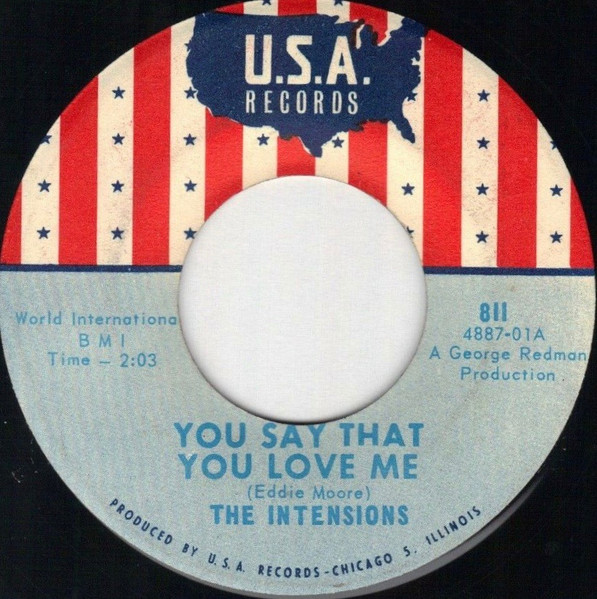
Another record label you were on was USA Records. Do you remember anything about how you got on that label, or who put you on the label?
**Sam Tate** 27:09
I was not aware that we were on USA.
**Bob Abrahamian** 27:13
Well, do you remember the songs “She Needs Somebody” and “You Say That You Love Me”?
**Sam Tate** 27:17
Yeah. Okay, yeah. At that point, George was handling the business end of it, so we had no knowledge of what labels he was going to with the music.
**Bob Abrahamian** 27:25
Okay. So I’m just trying to think of which one I should play next.
**Sam Tate** 27:32
Name them again, please.
**Bob Abrahamian** 27:34
Okay. “Can You Handle It?”
**Sam Tate** 27:35
Yes.
**Bob Abrahamian** 27:36
Okay. One thing that’s interesting is you did “Can You Handle It” as the Measures and as the Intensions. I’ll play the original version, and then we can talk some more.
So this is the Intensions with “Can You Handle It.”
**[music playing]** 27:52
The Intensions — “Can You Handle It”
**Bob Abrahamian** 30:17
Okay, that was the Intensions with “Can You Handle It.” They later remade that record as a group called the Measures, which we’ll talk about in a second.
One thing I wanted to note: on a lot of your records, you had a harder-edged kind of R&B sound, like on that record. Who sings lead on that record?
**Jimmy Jordan** 30:37
That’s me. That’s Jimmy.
**Bob Abrahamian** 30:39
Okay. So were your shows kind of based around that too? More of a rocking kind of sound?
**Jimmy Jordan** 30:49
We enjoyed performing onstage.
**Bob Abrahamian** 30:51
Okay. Did you have a specific act, or did you just come out and do the songs?
**Sam Tate** 30:58
All groups, you know, back in that era—one of the things every group did was dress alike, and they did movements and steps, which is not the case today.
But during that time, yeah, we had a routine, which we called a stage routine, that we did. Again, we dressed alike and we performed.
**Bob Abrahamian** 31:20
Okay. So you cut that record, and a lot of your records actually had that harder-edged sound, like we were just talking about.
One thing that’s interesting is that you cut a record as the Measures. What’s the story with that? You actually redid “Can You Handle It.” What’s the story?
**Jimmy Jordan** 31:41
After we left George Redmond, we came across the producer Barry Despenza, and we signed up with him. He wanted us to redo a remake of “Can You Handle It” again.
**Bob Abrahamian** 31:59
Okay. So did you have to change your name because of contractual things, or did he just want you to?
**Jimmy Jordan** 32:04
He wanted us to change the name. Barry Despenza changed the name.
**Bob Abrahamian** 32:07
So he came up with the name the Measures?
**Jimmy Jordan** 32:11
Right.
**Bob Abrahamian** 32:12
Okay. And you redid the song “Can You Handle It.” Were you together for much longer after that?
**Jimmy Jordan** 32:17
No.
**Bob Abrahamian** 32:19
So did you ever do shows as the Measures, or did you keep the name the Intensions for your shows?
**Jimmy Jordan** 32:24
A couple of shows as the Measures.
**Bob Abrahamian** 32:26
Okay.
**Jimmy Jordan** 32:27
With Barry.
**Bob Abrahamian** 32:29
Okay.
**Jimmy Jordan** 32:30
A couple of shows that he had booked for the group, we were under the Measures.
**Bob Abrahamian** 32:34
Okay. And then you eventually broke up after that, right?
So you were together for a while, and I guess the story with a lot of groups is that they’re together long enough, and then if they’re not successful, they kind of want to go on with their lives.
So what did you guys do after that? Sam, I know you were involved with engineering.
**Sam Tate** 32:52
Yes. I had that, and in fact I was married at the time as well, so I was dealing with a young family.
I ended up with radio station WVON as the street manager for some of the DJs there.
**Bob Abrahamian** 33:09
How did you get involved with managing some DJs?
**Sam Tate** 33:12
Well, the DJ Butterball had played our record, and I’m anxious. I’m at work listening—the first time it’s going on the air.
Before he played the record, he said, “Take out your tape recorders, because this is the last time you’re going to hear it.”
And he played the record. At the end of the record, he made a sound like he had smashed it.
And I’m going, “What?” You know, here I am waiting on my record for the first time.
So I called him and asked if I could take him to lunch, and he said yeah. I went down to take him to lunch, and when we were going to lunch, my main objective was to get on the expressway, speed up as fast as possible, beat him with one hand—
But when he explained to me why he had done that to my record, I understood it, and we ended up going on to lunch.
From there, it transpired into me becoming his street manager. That lasted for about seven years. It was really nice.
There was some misunderstanding about the management and how they had approached him. That was why he was angry.
**Bob Abrahamian** 34:19
So by street-managing the DJ, you mean the DJ would do sets at clubs?
**Sam Tate** 34:27
He would do sets at clubs. I would book those sets and make all the arrangements for it.
We became very close friends because we were in the same trade. He was an electrical engineer.
**Bob Abrahamian** 34:38
Okay.
**Sam Tate** 34:39
And so was I. But he ended up being a DJ because the DJ he was engineering for at [unclear] in Detroit, I think it was, got drunk and passed out.
So he had to complete the show, and they made him a DJ from then on.
**Bob Abrahamian** 34:57
That’s interesting. I never knew that’s how Butterball got started as a DJ.
And you said you managed some others?
**Sam Tate** 35:04
I did. I had things with Herb Kent, Cecil from the old WVON, and, you know, basically I did those on and off.
Butterball was my main client, and as I say, I was with him for probably seven or eight years.
**Bob Abrahamian** 35:24
Okay. Did you ever do any music stuff after that?
**Sam Tate** 35:28
No. No. I went from that, from management, and then [unclear]. I got out of that part of the industry as well.
**Bob Abrahamian** 35:38
Okay. And I know that Jimmy had done some music stuff after that too, a little bit.
I want to play more of your records just because you have a lot of records, and they’re all pretty good. I want to play them on the radio.
So this next record is called “She Needs Somebody,” and it came out on the USA label.
**[music playing]** 36:00
The Intensions — “She Needs Somebody”
**Bob Abrahamian** 38:01
Okay, that was the Intensions with a record they released on the USA label out of Chicago called “She Needs Somebody.”
If you’re just tuning in, we have two members of the Intensions, Sam Tate and Jimmy Jordan, talking about their group.
So right before I played that record, Sam was talking about how, after leaving the group, one of the things he did was become a manager—or I don’t know, “road manager” is the right word, I guess—for a lot of the WVON DJs when they did sets at clubs.
And Jimmy, you continued to do some music stuff, or at least you cut one more record. So after you broke up, did you and Eddie just keep singing together? What happened?
**Jimmy Jordan** 39:07
Yeah, we were working with these musicians, and they were doing a couple nights over in an area, and they needed a couple singers.
So Eddie and I decided to go out as a duo—two singers.
**Jimmy Jordan** 39:27
And we got hooked up with this producer, Reese.
**Bob Abrahamian** 39:32
Oh, Opie Reese. He ran the One-derful! label?
**Jimmy Jordan** 39:35
And we started writing a couple things for his label, for his company. He asked us if we would record something for him, you know, just A and F.
So we did a record for him, just the one thing.
**Bob Abrahamian** 39:51
Okay. So you actually wrote some stuff. You don’t remember now what artists you wrote for on his label?
**Jimmy Jordan** 39:57
No, not quite.
**[source transcript omitted / unavailable]** 39:57–45:00
A portion of the supplied transcript is missing here. It appears to include additional discussion and/or a record being played. This section should be restored from the audio rather than reconstructed from context.
**Bob Abrahamian** 45:00
So that record didn’t really get any play, right? You just put it out?
**Jimmy Jordan** 45:07
Right.
**Bob Abrahamian** 45:08
So did you ever do any more music, or record any more music, or anything like that since that record?
**Jimmy Jordan** 45:10
No, that was our last shot.
**Bob Abrahamian** 45:14
Okay. Well, even though you guys never did any more music, you definitely released a lot of records. You definitely put out enough stuff.
So I’ve got to say thanks so much for coming down to the studio and telling your story.
Do you guys have any last words for the audience?
**Sam Tate** 45:36
I’d like to say, for me, it’s been very fulfilling to hear these records that I haven’t heard in years myself.
And with the sound quality the way it is, I really appreciate you guys taking the time out to call us and try to get together for an interview.
Again, I really appreciate that.
**Bob Abrahamian** 45:57
Yeah. Thanks so much for coming down. You guys made the music.
**Jimmy Jordan / Sam Tate** 46:04
Thank you. Thank you.
**Bob Abrahamian** 46:06
Okay. Well, since we have time, I’ll play one more record by the Intensions. This is called “Baby, Baby, Release Me.”
**[music playing]** 46:14
The Intensions — “Baby, Baby, Release Me”
**[end of supplied transcript]**